
A Landmark in Limbo: Oakland’s Tribune Tower

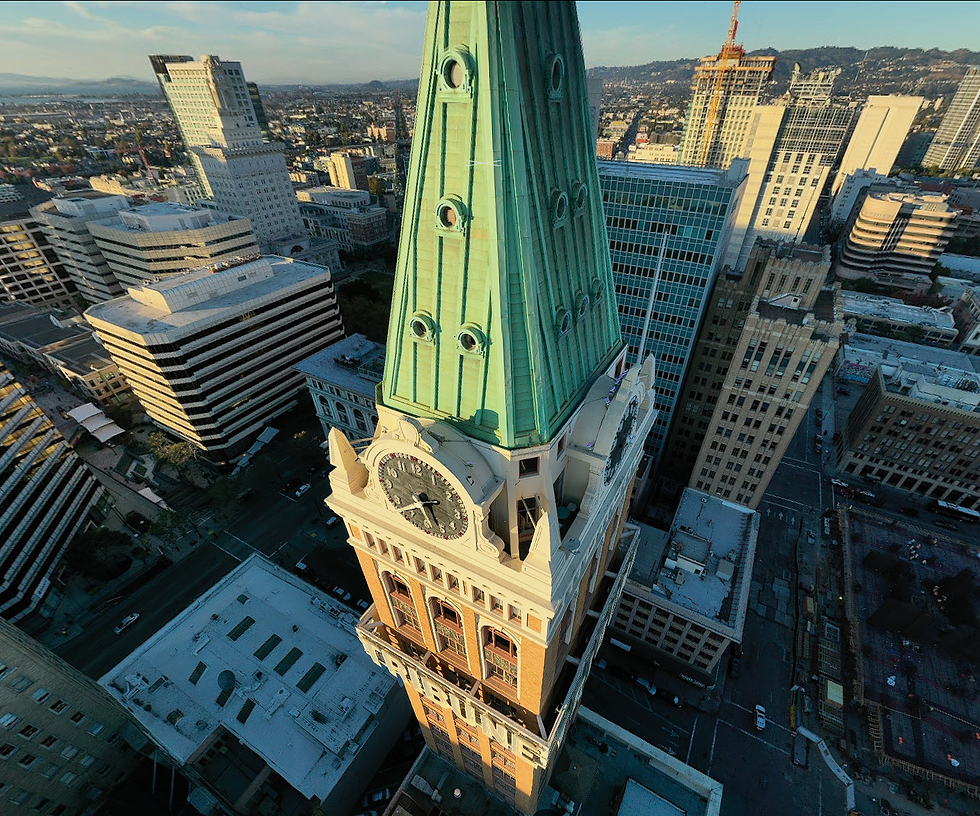
Arguably the most recognizable building in the city’s skyline has entered yet another difficult chapter. The historic tower, along with the Financial Center building at 405 14th Street and 1500 Broadway, is now under court-appointed receivership after ownership defaulted on a $111 million loan. The lender, Rialto Capital Management, moved to foreclose after Highbridge Equity Partners stopped making payments in 2025, and in September a judge appointed Christian Diggs of Touchstone Commercial Partners to step in and take control of the portfolio.
What the receiver found paints a sobering picture of the current condition of these once-prominent downtown assets.
According to court filings and reports, the Tribune Tower has suffered significant flood damage and ongoing vandalism. There have been instances of illegal entry, copper wiring theft and visible health and safety hazards inside the building, including abandoned mattresses, drug paraphernalia and unsanitary conditions. Broken windows and deferred maintenance have further compounded the deterioration. For a structure that defines Oakland’s skyline and carries deep historic identity, the reported state of disrepair is striking.
The issues are not isolated to the Tower. The 16-story Financial Center building at 405 14th Street is reportedly dealing with asbestos concerns, debris accumulation and nonfunctioning elevators , a major operational challenge for any multi-story office property. Meanwhile, 1500 Broadway, a 1920s-era historic building, is described as nearly vacant, with broken windows and plumbing and electrical problems adding to its list of capital needs.
Financial strain appears to have been building for some time. At the time the receiver assumed control, roughly $650,000 in property taxes across the three properties were reportedly outstanding, with another similar payment coming due in April 2026. The unpaid taxes were addressed in coordination with the lender, but they underscore the broader liquidity challenges facing the ownership group.
Highbridge Equity Partners acquired the three properties between 2016 and 2019, investing approximately $119.6 million during a period when downtown office values were significantly stronger and capital was widely available. In 2022, the firm refinanced with a $111 million floating-rate loan from Rialto. The refinancing paid off approximately $91 million in prior debt and was intended to fund future renovations and improvements across the portfolio.
However, the timing proved difficult. As the Federal Reserve began aggressively raising interest rates, floating-rate debt payments increased substantially. Monthly obligations climbed, occupancy challenges persisted across urban office markets, and by June 2025 loan payments reportedly stopped. A notice of default followed in August, and court filings indicate the unpaid loan balance exceeded $100 million at the time of action.
The Tribune Tower itself is no stranger to financial turbulence. The property has changed hands multiple times since the mid-2000s, including a $48 million acquisition in 2019. Like many legacy office assets, it has faced the combined pressures of aging infrastructure, shifting tenant demand and the broader re-pricing of downtown office product following the pandemic. Ground-floor retail has also struggled; a Southern-style restaurant previously occupying the Tower space closed after rent disputes and public safety concerns added further strain.
In many ways, this situation reflects what is happening across numerous urban office markets. Older Class B and historic buildings, particularly those requiring meaningful capital investment, have been disproportionately impacted by higher interest rates and reduced office utilization. Investors who relied on floating-rate financing during the low-rate environment have seen debt service costs escalate rapidly, squeezing already-thin margins. At the same time, tenants have become more selective, often gravitating toward newer, highly amenitized buildings or downsizing footprints altogether.
Receivership, while serious, does not necessarily signal the end of a property’s story. In many cases, it functions as a reset mechanism. A receiver’s role is to stabilize operations, secure the asset, address immediate safety concerns and preserve value while lenders evaluate long-term options. That could include a sale, restructuring, recapitalization or repositioning strategy.
The challenge, however, is valuation. Several Oakland office properties have traded in recent years at steep discounts compared to their pre-pandemic pricing. For assets with significant deferred maintenance, leasing challenges and required environmental remediation, the buyer pool narrows even further. Any future transaction involving the Tribune Tower or its companion properties will likely reflect both the cost of capital improvements and the recalibrated expectations of today’s office market.
At the same time, these buildings occupy prime locations in the heart of downtown and carry historic and civic significance. The Tribune Tower in particular remains an architectural icon. For the right investor with a long-term vision and access to patient capital, there may be opportunity in repositioning or adaptive reuse, particularly if downtown Oakland continues its broader recovery efforts.
For now, the focus remains on stabilization. The receiver has acknowledged the importance of these properties to the community and the intention to play a role in their revival. Whether that revival comes through new ownership, redevelopment, or a longer restructuring process will depend on market conditions, capital availability and investor confidence in downtown Oakland’s trajectory.
What is clear is that the story of the Tribune Tower and its neighboring properties is bigger than a single loan default. It reflects a structural shift in how office real estate is valued, financed and operated in a post-pandemic, higher-rate environment. Downtown Oakland is navigating a period of recalibration. The next chapter for these landmark buildings will be shaped not only by lenders and investors, but by the broader question facing cities nationwide: how to reposition legacy office assets for a fundamentally changed market.


Comments